For millions of people, bunions are a real, often painful problem. In the U.S. alone, there are around 1.1 million people each year who are surgical candidates for bunion correction.
Until recently, the standard bunion surgery (called open osteotomies or fusion) involved cutting and realigning bone, often with large incisions and a long recovery period. But over the past decade, there’s been a clear shift towards newer, implant-based systems like the HyperFlex. These come with smaller incisions, less soft tissue damage, and much shorter recovery times.
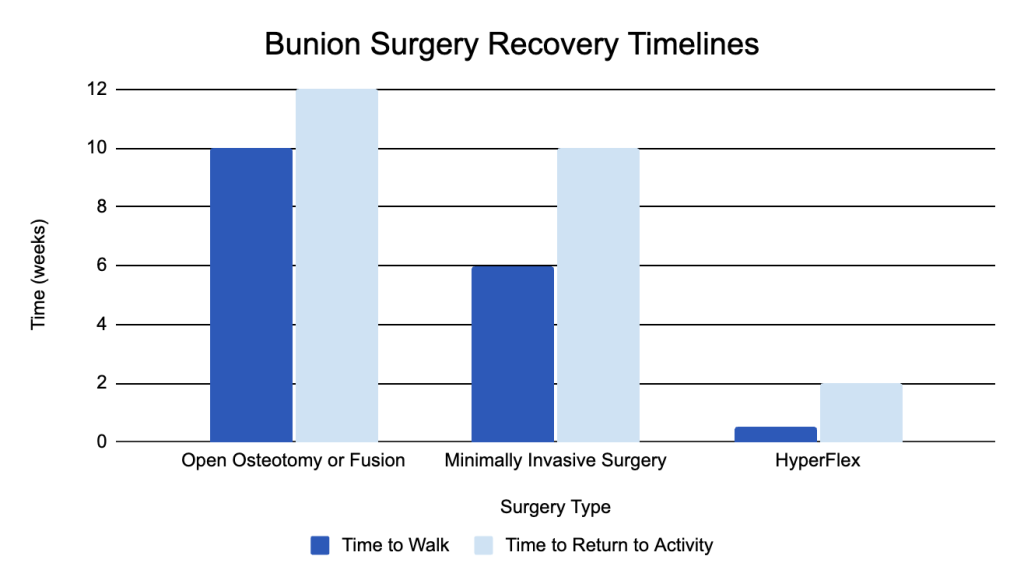
In general, bunion surgery recovery time takes 10-12 weeks to recover from, assuming you have traditional open ostectomy surgery. In this guide, we’ll explore how age and health status affect your recovery, and compare traditional surgical techniques vs. newer, minimally invasive bunion surgery methods.
Bunion Surgery Recovery Time by Surgery Type
| Bunion Recovery Timeline Based on Surgery Type | ||||
|---|---|---|---|---|
| Surgery type | Typical time required to wear surgical boot | Typical time to walk in sneakers | Typical time to return to low-impact activity | Notes |
| Traditional open osteotomy/fusion | ~3–6 weeks | ~10–12 weeks | ~12+ weeks | 6–12+ weeks for bone healing; common guidance is 10–12 weeks until normal shoes can be worn. |
| Minimally invasive (PECA/Chevron MIS/Lapidus MIS variants) | ~3–6 weeks | ~6–8 weeks | ~8–10 weeks | Results vary depending on the specific type of minimally invasive procedure. |
| HyperFlex (bone-preserving implant system) | Not usually required | Immediately after surgery for many patients | ~2–6 weeks | Most patients can walk immediately after surgery, but still require rest and elevation to allow incision to heal |
Source 1 | Source 2 | Source 3
Traditional bunion surgery, often called an open osteotomy or fusion, has been the gold standard for decades. In this procedure, the surgeon makes a larger incision, cuts and repositions the bone, and often uses screws or plates to hold the correction in place.
Because the bone itself is being reshaped and must fully heal, recovery can be slow. Most patients spend several weeks in a surgical shoe or boot before transitioning back into supportive footwear. It’s not unusual for it to take 10–12 weeks before walking comfortably in normal shoes, and swelling can linger for months.
On the other end of the spectrum, newer technologies like HyperFlex aim to preserve more of the natural bone structure. Instead of cutting through the bone, the system uses a specialized implant designed to realign and stabilize the joint with minimal disruption to surrounding tissue.
This bone-preserving approach, combined with a smaller incision, means there’s less scarring and trauma for the body to repair. As a result, many patients can bear weight almost immediately, don’t require a surgical boot, and may even be able to walk out of their surgery in a comfortable pair of sneakers.
Recovery Timeline by Patient Demographics
Like any surgical procedure, a patient’s age, health status, and bunion severity can all affect how their body heals. Let’s take a look at how patient demographics impact the bunion surgery recovery timeline:
| How Demographics Impact Bunion Surgery Recovery | ||||
|---|---|---|---|---|
| Patient Factor | HyperFlex Recovery | Minimally Invasive Recovery | Traditional Surgery Recovery | Key Considerations |
| Age 20-40 | About 6 weeks | About 6–8 weeks | About 12–16 weeks | Incision wound and bruising heals fastest in this age group |
| Age 40-60 | About 6 weeks | About 8–12 weeks | About 16–24 weeks | Moderate healing response, more variability between patients |
| Age 60+ | About 6 weeks | About 10–16 weeks | About 24–36 weeks | Slower healing, higher complications in certain individuals |
| Diabetic Patients | About 6-8 weeks | About 12-20 weeks | About 24-48 weeks | Complications like infections become more prevalent |
| Severe Bunions | About 6 weeks | About 12-16 weeks | About 20-28 weeks | May require open surgery |
| Athletes | About 6 weeks | About 8-12 weeks | About 20-32 weeks | Generally a faster return to activity |
Source 1 | Source 2 | Source 3
Factors That Accelerate Recovery
As well as age and the type of bunion surgery, there are a few other factors that can affect a patient’s recovery, including:
- Pre-Surgery Health: Patients in good cardiovascular health with controlled blood sugar levels tend to heal faster than those with uncontrolled medical conditions.
- Compliance with Instructions: Following post-operative guidelines reduces complications and accelerates return to normal activities.
- Physical Therapy: Patients who complete recommended exercises and physical therapy often return to full function earlier than those who do not.
Bunion Surgery Success and Satisfaction Rates
The success rate of bunion surgery is around 90% for most patients, and many patients experiencing an unfavorable outcome are often dealing with lingering pain or significant scarring. Bunion recurrence may happen in up to 24% of patients after surgery, but with the right post-operative care, around 95% of healthy patients don’t require a second surgery.
Some types of bunion surgeries also have higher patient satisfaction rates than others. For example, surgeries requiring long recovery times or significant lifestyle changes may lead to lower patient satisfaction, even if the surgery itself is successful. This is why options like the HyperFlex are so valuable for patients; the HyperFlex is effective, minimally invasive, and often dramatically reduces recovery time.
What Patients Should Expect During Recovery
Based on both clinical data and patient experiences, recovery after bunion surgery follows different timelines depending on the procedure performed. Minimally invasive options often mean walking the same day and getting back to work or exercise much sooner, while traditional open surgeries typically require longer periods of rest, protective casting, and a slower return to normal footwear. Here’s a week-by-week snapshot of what you can realistically expect:
| What to Expect After Bunion Surgery | |||
|---|---|---|---|
| Timeline | HyperFlex | Minimally Invasive Surgery | Traditional Open Surgery |
| Days 1–7 | Usually immediate weight-bearing in supportive shoes Many patients walk the same day with minimal pain | Walk immediately in a surgical shoeMinimal painReturn to desk work is possible | Non-weight bearingCast or boot requiredSignificant pain management |
| Weeks 2–4 | Light exercise and walking are possible without significant discomfort | Transition to comfortable sneakersLight exercise permitted | Gradual weight-bearing may beginEarly physical therapy starts |
| Weeks 6–12 | Many patients resume athletic activities by 4–6 weeksUsually comfortable in formal shoes | Return to most athletic activitiesComfortable in formal shoes | Return to work is possible Limited shoe options remain |
| Months 3–6 | Full recovery is commonly achieved by 3 monthsMost patients are cleared for all activities | Full recovery is commonly achieved by 6 monthsAll activities cleared, including high heels | Ongoing recoverySome activities restricted |
| Months 6–12 | Full recovery | Full recovery | Full recovery expected, though some patients experience permanent limitations |
Reduce Bunion Surgery Recovery Time with HyperFlex
If you require bunion surgery and want to minimize your recovery time, pain, and scarring, consult with a specialist experienced in advanced, minimally invasive techniques. As the inventor of the revolutionary HyperFlex technology, Dr. Josef Geldwert is an expert, New York-based surgeon who can help ensure your bunion surgery is a success.
Why settle for a six-month recovery when you could walk immediately after your surgery? Reach out to Geldwert Bunion Center to learn how we can help reduce your bunion surgery recovery time and get you back on your feet as quickly and comfortably as possible.
Call our office at 914-875-1632 or contact us here to set up your consultation.